There are ceiling fans that cool a room, and then there are ceiling fans that define one. Fanimation has built its entire identity around the second category. Founded in 1984 by Tom Frampton in Pasadena, California, Fanimation started with a straightforward ambition that turned out to be anything but ordinary: to produce ceiling fans so visually striking and mechanically excellent that they could not be ignored. That ambition has held for over four decades now, and the brand that began as a garage startup supplying hotels, restaurants, and boutique commercial spaces has grown into one of the most respected names in the premium ceiling fan market, holding more than 400 registered patents and continuing to push the boundaries of what a ceiling fan can look like and how it can function.
Understanding what makes Fanimation different from the major mass-market brands requires understanding what it was never trying to be. Fanimation was not founded to compete with Hampton Bay or Harbor Breeze on price. It was founded to make ceiling fans that interior designers would specify, that hospitality professionals would choose for high-end restaurants and hotel lobbies, and that homeowners with discerning taste would select when they wanted a fan to be the focal point of a room rather than a fixture that blends into the background. That positioning has shaped everything about how the company designs its products, prices them, and supports them over time.
The Story Behind the Brand
Tom Frampton’s connection to ceiling fans predates Fanimation by more than a decade. His interest in the category began in 1973 when, at seventeen years old, he went to work for an antiques dealer whose inventory occasionally included vintage ceiling fans. That early exposure planted a fascination that would eventually shape his career. By the early 1980s Frampton had spent time at the Casablanca Fan Company, where Fanimation originated as an internal specialty department focused on unusual and high-design fan concepts before spinning off as an independent company in 1984.
The first years were characteristically entrepreneurial — the garage served as production facility, the customer base was almost entirely commercial, and the fans that Frampton developed were distinctive enough that hotels, bars, and restaurants became reliable early adopters. The memorable designs and quality construction that characterized those early models gradually built a reputation that attracted private residential orders, and as demand grew the company relocated from Southern California to Indianapolis, Indiana in 1994 to take advantage of better manufacturing infrastructure. The company moved again in 2003 to its largest facility to date in Zionsville, Indiana, where it remains headquartered today.
A milestone that speaks to the cultural reach of the brand came in 2004, when Fanimation’s futuristic Enigma model appeared in the Will Smith blockbuster “I, Robot” — a moment of Hollywood product placement that underscored just how far the brand’s aesthetic ambitions had taken it from the world of conventional ceiling fans. In 2007, founder Tom Frampton’s son Nathan became chairman of the company while Tom continued as CEO, marking the transition to second-generation family leadership that continues to guide the brand today. Around 2014, Fanimation began integrating DC motor technology and smartphone app control into its product line, and the fanSync smart control platform that defines their current lineup was developed through this period of technological expansion.
Design Philosophy: Three Decades of Functional Art
The phrase “functional art” gets used loosely in product marketing, but in Fanimation’s case it describes something the brand has genuinely committed to across its entire history. Where most ceiling fan manufacturers organize their design process around a relatively small set of blade shapes, motor housing profiles, and finish combinations, Fanimation has consistently explored materials, mechanisms, and aesthetic references that most fan companies simply never consider.
The natural world has been a persistent source of inspiration since the brand’s earliest models. Palm leaf blades — now a common feature across dozens of ceiling fan brands — were pioneered by Fanimation with the Punkah, a fan so different in its operating mechanism that it defies easy categorization. Rather than spinning continuously in one direction, the Punkah’s blades rock back and forth in a pendulum motion, creating a gentle oscillating airflow that evokes the slow sweep of a hand fan. The Punkah can be ceiling-mounted or wall-mounted horizontally, and its movement is so visually distinctive that it functions as kinetic sculpture as much as cooling equipment. Fans with hand-carved wood blades, bamboo construction, canvas panels, and other natural materials have followed in the same tradition, bringing organic texture and craft into spaces where conventional plastic and medium-density fiberboard simply cannot compete aesthetically.
Historical references form another design thread running through the Fanimation catalog. Belt-drive fan systems — the industrial ceiling fan configurations where a single motor drives multiple fan heads through a system of connected leather or rubber belts — have been a Fanimation specialty that became a defining aesthetic of upscale industrial-style restaurants and commercial spaces. Art deco designs, replicas of antique desk fans scaled to ceiling installation, and ornate Victorian-influenced models have all found homes in the Fanimation lineup over the years. The company’s Antique Fan Museum, established on their Indiana premises in 2008 and relocated and reopened in 2009, reflects just how seriously the brand takes the history of fan design as both inspiration and legacy.
At the contemporary end of the design spectrum, Fanimation continues to produce models that test what a ceiling fan is allowed to look like. Asymmetrical designs with single blades, galvanized steel housings paired with directional halogen spotlights, fans where the blades appear to float in midair through concealed mounting hardware — these are not concept exercises but actual production models available for purchase and installation. The brand’s signature “slow motion” speed setting, which rotates blades at twenty-five to thirty revolutions per minute, was developed specifically to create visual atmosphere in hospitality environments where the fan’s movement itself contributes to the mood of the space.
DC Motor Technology and Energy Efficiency
Fanimation’s integration of DC motor technology into its lineup, which began in earnest around 2014, represents one of the more significant engineering commitments the brand has made. The difference between a conventional AC motor ceiling fan and a DC motor ceiling fan is not merely incremental — it is a fundamentally different approach to how the fan generates and sustains rotation, with meaningful consequences for energy consumption, noise levels, available speed settings, and long-term reliability.
A standard AC motor ceiling fan requires continuous electrical power to maintain rotation, drawing current throughout its operation to keep the motor turning. A DC motor ceiling fan, by contrast, uses a stationary magnetic field that requires a brief power input to bring the fan up to speed and then relies on the magnetic drive to sustain rotation with significantly reduced ongoing power draw. The practical result is energy consumption up to seventy percent lower than a comparable AC motor fan — a difference that translates into real savings on utility bills over the years of a fan’s service life, and that has allowed many Fanimation DC motor models to achieve Energy Star certification.
The operational characteristics of DC motors also produce benefits beyond energy savings. DC motor fans run with virtually no audible noise at any speed setting, which matters significantly in bedrooms, nurseries, home offices, and other environments where fan hum or vibration would be disruptive. DC motor fans also support a wider range of speed settings than the standard three-speed configuration of most AC motor fans — six speeds rather than three is typical — giving owners more precise control over airflow and comfort. Fanimation’s DC motor lineup spans a broad range of designs, from contemporary transitional models to their signature statement pieces, so the efficiency benefits of the motor technology are available across the brand’s aesthetic spectrum rather than being confined to a single product tier.
fanSync Smart Controls
Fanimation’s fanSync smart control platform represents the brand’s answer to the growing consumer expectation that ceiling fans should integrate with smartphone control and smart home ecosystems. fanSync allows you to manage fan speed, light output, rotation direction, and timer functions directly from your smartphone or tablet via a Bluetooth or Wi-Fi connection, eliminating the need for wall controls or handheld remotes for everyday operation. The platform integrates with Amazon Alexa and Google Assistant, enabling voice control for hands-free operation of fan speed and lighting.
The practical value of smart control becomes particularly apparent in multi-fan installations where coordinating settings across several fans in a home or commercial space would otherwise require visits to each individual wall control. fanSync allows you to control multiple fans from a single app interface, create schedules that automate fan operation based on time of day or temperature, and adjust settings remotely from outside the home — a feature that matters for vacation properties or for pre-conditioning a room before you arrive home.
Not every Fanimation model is fanSync-compatible, and the brand clearly marks which fans in its catalog support smart control integration versus which are operated by conventional wall or remote controls. For buyers who want smart home integration as a primary feature, confirming fanSync compatibility before selecting a model is an important step in the buying process.
The Odyn: A Flagship Example
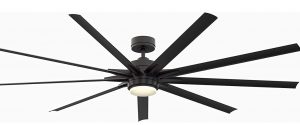
The Fanimation 84-inch Odyn outdoor ceiling fan illustrates many of the brand’s core strengths in a single model. At 84 inches of blade span it sits firmly in large-fan territory, designed for great rooms, covered outdoor entertaining areas, commercial spaces, and anywhere that a standard 52-inch fan would simply move inadequate air. The nine-blade configuration and wet rating make it appropriate for fully exposed outdoor installation where contact with rain and moisture is a real-world condition rather than an occasional risk, and the engineering standards that wet rating requires — sealed motor, weather-resistant materials throughout, corrosion-resistant hardware — ensure that the fan can handle those conditions across seasons and years of continuous service.
The smart features built into the Odyn reflect Fanimation’s approach to technology as a practical enhancement rather than a marketing checkbox. The Safe Exit function allows you to command the fan off with a one-minute delay — useful in a room you are leaving where you want the air to circulate briefly after you go rather than stopping abruptly. The Home Away feature simulates occupancy by turning the fan light on and off at programmed intervals, a security-oriented function that has obvious practical value for vacation homes and rental properties. These are not features you find on budget fans, and they reflect the thoughtfulness that characterizes the Fanimation approach to product development across its lineup.
Motor Quality and Warranty Coverage
The mechanical foundation of Fanimation’s reputation rests substantially on motor quality. Many Fanimation ceiling fans use an 18-pole split-capacitor motor design modeled after the Emerson K55 — the same motor architecture that has made Emerson and Casablanca fans legendary for longevity and smooth operation among ceiling fan enthusiasts and industry professionals. The 18-pole configuration provides smoother, more consistent torque than the standard 9-pole motors found in most consumer fans, which translates into quieter operation, less vibration, and more reliable starting across thousands of operational cycles. Fans built around this motor design carry a lifetime warranty on the motor itself, reflecting the manufacturer’s confidence in its long-term reliability.
Other Fanimation models use 188x25mm motor configurations and carry a 35-year warranty — coverage that far exceeds the industry norm for residential ceiling fans and that signals a genuine commitment to product longevity rather than planned obsolescence. Blade sets are typically excluded from these warranty terms, as is standard across the industry, but the motor and electrical components that determine a fan’s functional life are covered at a level that reflects premium positioning. For buyers weighing the higher upfront cost of a Fanimation fan against more affordable alternatives, the warranty terms are a meaningful part of the total value equation.
Outdoor Ratings and Installation Flexibility
Fanimation’s outdoor-rated lineup covers the full spectrum of moisture exposure conditions that residential and commercial installations require. Dry-rated fans are appropriate for covered indoor spaces with no moisture exposure. Damp-rated fans handle covered outdoor areas — porches, patios, and pergolas where the fan will not be directly rained on but where humidity and ambient moisture are constant conditions. Wet-rated fans like the Odyn are engineered for direct exposure to rain and weather, making them appropriate for open outdoor areas where complete weather protection cannot be guaranteed.
The breadth of Fanimation’s outdoor lineup reflects the brand’s historical strength in commercial and hospitality applications where outdoor covered dining, resort pool areas, and open-air entertainment spaces demand ceiling fans that perform reliably in challenging conditions without sacrificing the visual quality that those premium environments require. A wet-rated Fanimation fan installed on a covered terrace or open patio brings the same design intentionality and mechanical quality as the brand’s indoor models, which is not something you can say about most ceiling fans whose outdoor ratings are an afterthought rather than a primary engineering consideration.
Who Fanimation Is For
Fanimation fans are not the right choice for every ceiling fan application, and the brand makes no effort to pretend otherwise. If your priority is lowest cost, broadest retail availability, or fast-turnaround parts support from big-box hardware stores, there are brands better suited to those needs. What Fanimation offers instead is design originality that no other mainstream ceiling fan manufacturer can match, motor quality and warranty coverage that justify a premium price over a long service life, smart control integration that meets the expectations of a connected home, and the particular satisfaction of owning a product that was designed to be noticed.
For the right setting — a great room that needs a statement piece, an outdoor entertaining area that deserves more than a generic contractor fan, a commercial space where the ceiling fan is part of the designed atmosphere rather than just a utility fixture — Fanimation is the answer that no other brand can provide. Browse the catalog with your specific space in mind, and there is a very good chance you will find something that changes how you think about what a ceiling fan can be.